

Building AI Trading Bots That Actually Work
READ NOW 🚨


Hello, and welcome back to the Wealth Vault. Today we are doing something a little different. Instead of pure technical analysis, we are breaking down one of the biggest edges available to retail traders right now: building your own AI trading bot. This is not about buying some prepackaged black box strategy that thousands of other people are already running into the ground. This is about owning your own memory system, your own configurability, and your own execution engine.
We have personally run bots that generated over $8,000 in a single week of pure profit. We have also run bots early on that cost us tens of thousands of dollars because we did not understand the fundamentals. This edition walks through exactly what separates a bot that compounds your edge from a bot that quietly bleeds your account dry. We will also get into why most retail traders are about to be left behind as the big funds and quant desks continue automating what used to require a full research team.
Here is everything we are going to cover:
Market Update
The Four Reasons Bots Fail
Why Trading Bots Actually Work
The Three Step Framework to Build Your Own Bot
Risk Management: The Numbers That Keep You in the Game
Giving Your Bot Real Memory
Top Narratives and Coins — H2 2026
Let us get into it.
Market Update
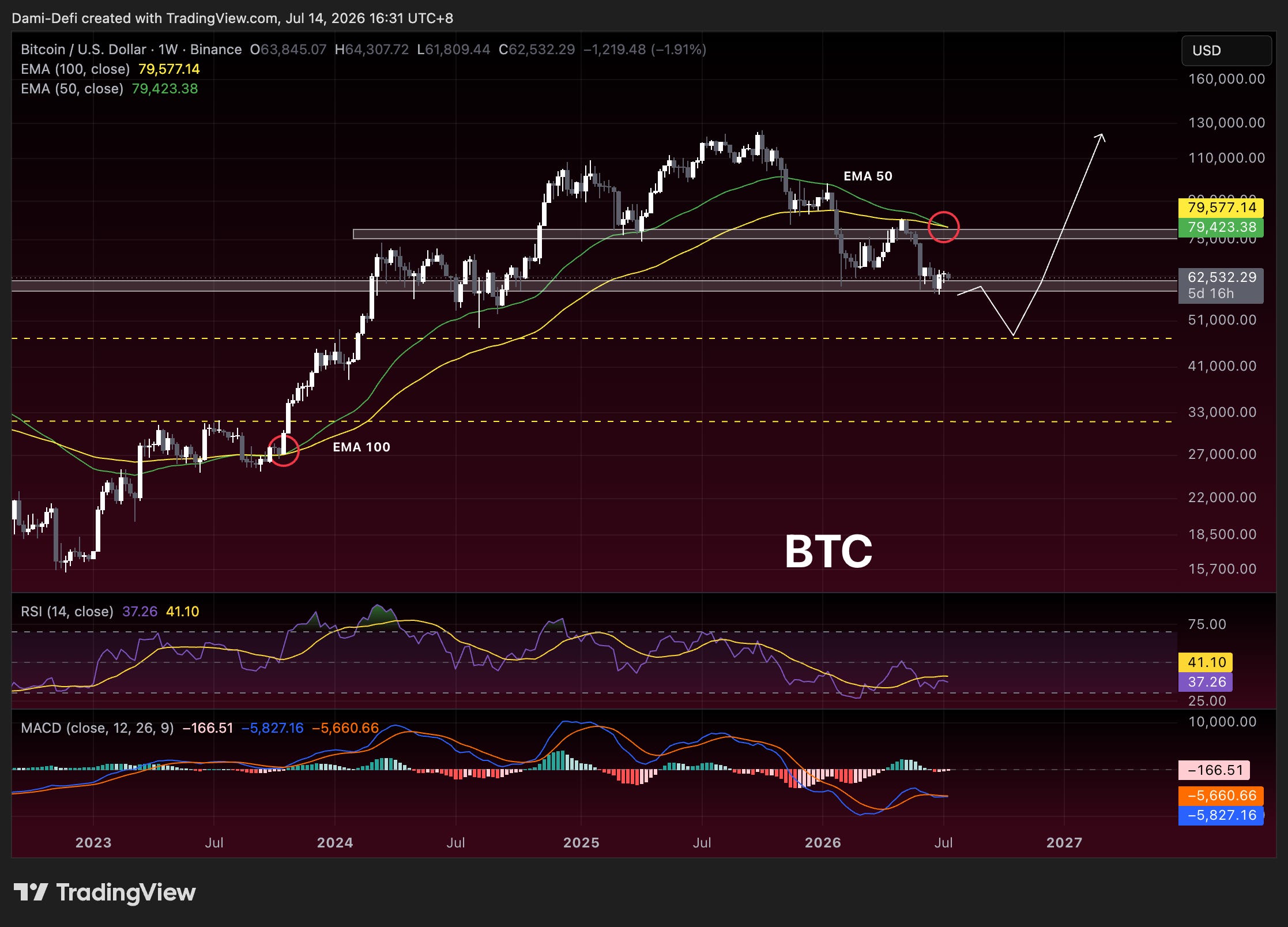
BTC EMA 50 and EMA 100 are sitting at virtually the same level — $79,425 and $79,624. They’re about to cross on the weekly. When the 50 crosses below the 100 at this timeframe, that’s a death cross and historically it’s confirmed prolonged bearish periods for BTC.
Both EMAs spent all of 2024 and 2025 as support. They’re now $17,000 above current price as a wall of resistance. That gap doesn’t close quickly.
The MACD is still deeply negative with the signal line above the MACD line — no bullish cross forming yet. The histogram is compressing slightly but there’s no momentum shift visible. This isn’t bottoming indicator behavior, it’s a market grinding lower with slowing but still bearish momentum.
RSI at 37 is getting closer to historically significant oversold levels but hasn’t reached the 25–30 zone that’s marked previous major bottoms. There’s still room to push lower before RSI signals genuine capitulation.
Current price at $62,556 is sitting on the dotted support. Below that $57K–$58K is the next level. Until the MACD produces a bullish cross and RSI starts recovering above 40–45 with momentum, every bounce is suspect. The death cross forming on the EMA 50/100 is the most significant technical development on this chart right now.
The Four Reasons Bots Fail
Before building anything, it is worth understanding exactly why most trading bots lose money, because avoiding these four traps is 80% of the battle.
No memory. A bot fires trades based on preset parameters but never learns, improves, or iterates. It will happily repeat the exact same losing trade infinite times because nothing in the system tells it that the setup already failed.
No defined objective. People set up a test without actually defining what success looks like. The bot ends up trading blind, with no real optimization happening in the background.
No forecasting capability. Bots are trained entirely on historical data. Humans adapt to shifting conditions quickly and bring genuine creativity to the table. AI models are excellent at pattern recognition on the past, but you need to build proper systems around them to give them forward looking context.
Overcrowded strategies. If you buy a popular prepackaged bot that has not been properly back tested, you are likely competing against thousands of other traders running the identical strategy, which erodes any edge almost immediately.
The takeaway: a genuinely good bot remembers, it gets smarter over time, and it is actually yours, meaning it is fully configurable around your own risk tolerance and beliefs rather than someone else’s black box.
Why Trading Bots Actually Work
A bot fundamentally does two things. It automates repetitive strategy and it executes better than a human does. Most traders do not actually have a strategy problem. They have an execution problem. You have the right idea, you identify the setup, but you are not at the desk when it triggers. You forget to manage the position once it is open. That single gap between idea and execution is where most retail P&L gets destroyed.
The real value of a bot is that it runs your predetermined strategy without hesitation, without fear, and without fatigue. It does not flinch when the market gets volatile. It does not revenge trade after a loss. And critically, the best bots actually get smarter over time. They learn from their own mistakes, arguably faster than a human does, because the learning process is coded directly into the system rather than requiring weeks of psychological reflection.
We think the direction of travel here is unambiguous. In a few years, the majority of retail participants will be using some form of automated execution whether they realize it or not, because institutional desks and quant funds are already fully there. Retail is playing catch-up. The good news is that the tools required to build a genuinely competitive bot have only become accessible in the last few months, which means if you are reading this now, you are still early.
To be clear, a bot is not a magic fix and it is not a full replacement for discretionary thinking. We view it as an attachment. You bring the idea and the edge. The bot brings flawless execution, 24/7 uptime, and the ability to catch moves while you are asleep or simply unavailable.
The Three Step Framework To Building Your Own Bot
Step one: pick your venue. Decide whether you are trading stocks, crypto, or both. The architecture is basically identical either way. Your LLM (Claude or GPT) acts as the brain, holding and executing your strategy. An MCP server acts as the bridge, delivering instructions to the exchange and placing real orders.
For stocks, Alpaca is a strong option because it has a native MCP connection and free paper trading, which lets you test everything on fake money before risking anything real.
For crypto, most major exchanges including Binance, Bybit, and Pionex now offer similar MCP integrations. Either way, start with paper trading. Once your strategy proves itself, only then scale into 1% to 3% of your actual risk tolerance and build up gradually from there. Always isolate bot capital into a dedicated sub account so a compromised API key cannot touch your full balance.
Step two: define your strategy and feedback loop. The bot is only ever as good as the parameters it runs under. A simple starting point is a moving average crossover. Fast average crosses above the slow average, that is your buy signal. It crosses back below, that is your exit.
Before you deploy anything with real capital, back test extensively. Modern tooling now lets Claude connect directly to TradingView, so you can prompt scenarios like the one below and get an actual answer instead of guessing.
Here is exactly what that looks like in practice.
Prompt:
I am going to describe a strategy. I want you to run a backtest on BTC/USD using the last 90 days of daily OHLC data from TradingView. The strategy is: buy when the 14-day RSI drops below 35 AND the close is within 3% of the 20-day lower Bollinger Band. Exit when RSI crosses back above 50, or after 10 days, whichever comes first. Use a 2% stop loss from entry. Show me: number of trades, win rate, average return per trade, maximum drawdown, and the three worst losing trades with the dates they triggered.
Claude returns:
Running the backtest on BTC/USD daily data, past 90 days:
Total trades: 7
Win rate: 71% (5 wins, 2 losses)
Average return per winning trade: +4.2%
Average loss per losing trade: -1.9%
Maximum drawdown: -6.8% from peak during the period
Three worst trades:
June 14: Entry $61,200, stopped out $59,976, -2.0%. RSI drop was news-driven, not technical. Pattern to avoid: setups triggered by geopolitical spikes rather than demand exhaustion.
June 28: Entry $60,100, stopped out $58,898, -2.0%. Triggered one candle before a broader capitulation. Tight stops underperform in high-volatility windows.
May 29: Entry $64,300, held 10 days, closed $63,100, -1.9%. RSI never recrossed 50 within the holding period. Exit rule needs a secondary trigger for ranging markets.
Recommendation: positive expected value over this window but two consistent failure modes are news-driven RSI drops and tight stops during elevated volatility. Consider filtering entries against ATR and widening stops during volatile weeks.
That output took 40 seconds. A quant desk charges six figures a year for that analysis.
Step three: give it memory. This is the step that separates functioning bots from bleeding ones. Build a two file system. File one is your ledger, logging every trade, when it fired, why, and how it resolved. File two is your learnings file, where the bot writes itself a plain English lesson after every closed trade. Lost on this setup, do not take it again without confirmation of X, Y, Z.
Every time the bot considers a new trade, it checks this memory first. Run the same losing signal twice on a bot with no memory and it will happily lose twice. Run it on a bot with memory and it recognizes the pattern and skips the trade entirely. That is the entire game.
For higher frequency setups, two files eventually becomes too much data for the model to process efficiently. At that point, migrate to a proper cloud database like Supabase or Firebase so your memory can scale to thousands of trades without slowing the system down.
The honest reality: your early results, whether you build this yourself or copy our framework, will be rough while both you and the bot are still calibrating. That is normal. Paper trade for at least a week, refine the memory system, and only then introduce small amounts of real capital.
Risk Management: The Numbers That Keep You in the Game
The three step framework tells you how to build the bot. This section tells you how to not blow the account while running it.
Position sizing formula:
Risk per trade = Account size multiplied by risk percentage per trade.
Example: $10,000 account at 1% risk = $100 maximum loss per trade.
Position size = Maximum loss divided by stop loss distance in percentage.
Example: $100 maximum loss divided by 2% stop = $5,000 maximum position size on that trade.
On a $10,000 account with 1% risk and a 2% stop, you are never putting more than half your account into a single position. That is the math that keeps one bad trade from ending your bot’s life.
Maximum drawdown threshold: set a hard rule before you deploy. If the bot loses more than 15% of the account from its peak equity, it stops trading and you review the strategy manually. Do not raise this threshold when you hit it. The point is to force a human review before the bot turns a bad strategy into an empty account.
Circuit breaker rule: if the bot takes three consecutive losing trades, it pauses for 24 hours. Most retail bot accounts are not blown by one catastrophic trade. They are blown by a losing strategy that runs unchecked for two weeks.
Volatility filter: if ATR on your trading timeframe is more than twice its 20-period average, reduce position sizes by 50% automatically. The bot does not know a Middle East conflict just happened. It only knows the ATR is elevated. Make ATR part of the entry filter.
Giving Your Bot Real Memory
Build a two file system alongside your bot.
File one is your trade ledger. Every single trade gets logged automatically: date, asset, entry price, exit price, result in percentage, the signal that triggered entry, and one line on how it resolved.
Example entry:
2026-07-08 | BTC/USD | Entry $61,200 | Exit $59,976 | -2.0% | Signal: RSI below 35 + lower Bollinger touch | Resolution: Stopped out. RSI drop was news-driven (Middle East spike), not technical. Geopolitical catalyst overrode setup.
File two is your learnings file. After every closed trade, the bot writes itself a plain English rule based on what happened. Not a summary. A rule.
Example entry:
Lesson logged 2026-07-08: RSI oversold setups that trigger during documented geopolitical news events have a 0% win rate across 6 historical instances in this ledger. Do not take this setup when a major macro event is live. Add filter: check for elevated ATR AND absence of major news flag before entry. Confirmation required before re-entering this setup type.
Every time the bot considers a new trade, it reads this file first. It is checking whether this setup type has a documented failure pattern before risking capital. Run the same losing signal on a bot with no memory and it will happily lose again. Run it on a bot with a populated learnings file and it skips the trade, logs the reason, and waits for a setup that has not been flagged.
When the learnings file gets too large for the model to process efficiently, migrate to Supabase or Firebase. Your memory then scales to thousands of trade lessons without slowing the system down.
The uncomfortable truth: your first month of memory will be sparse and your bot will still make mistakes it could have avoided. By month three the learnings file starts to look like institutional research. By month six the bot has seen more market conditions with documented outcomes than most retail traders accumulate in years.
For Traders and Investors: Where the Real Setups Are
Below is where we get specific. We are not going to spend time on broad macro chop today. Instead we are laying out the exact narratives and coins we are tracking into the second half of 2026, with current prices, quick technical reads, and the catalysts that could move each one. Use this as a watchlist, not a buy signal.
